A little po-mo:
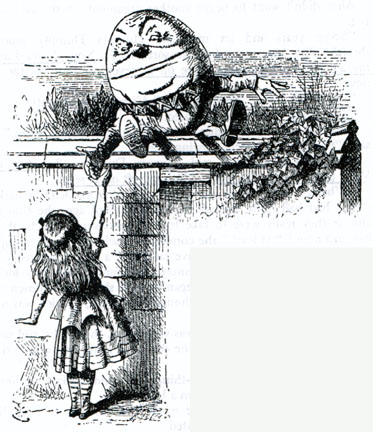
Post-modern is clearly a humpty-dumpty word, meaning whatever one wants, although originally merely a term of literal chronological import, ie, that which comes after modernism. Very roughly (and totally depending upon interpreter) modernism seems to be 1875 - 1940 and postmodernism 1940 - ... Some commentators then identify different generations of postmodern, designated (implausibly) with and without the hyphen:
 "For
the sake of clarity, I use the original form of the word (in which the hyphen
privileges the modern) to refer to the first of these two generations, which
sees itself as extending the project of modernism. In "postmodernism,"
on the other hand, the hyphen has dropped out and the agglutinated form, in
which "post" gets top billing, implies the emergence of a new entity."
- Humpty dumpty strikes again!
There does seem to be some connection as between conceptual thesis and antithesis
between modern and postmodern:
"Postmodernism, in contrast, doesn't lament the idea of fragmentation,
provisionality, or incoherence, but rather celebrates that. The world is meaningless?
Let's not pretend that art can make meaning then, let's just play with nonsense."
Some concisely turn this nonsense to the matter in hand:
"Postmodernism, by definition resists definition. Theoretically, postmodernism
can only theorise its own conditions of impossibility; with neither a fixed
subject nor object there can be no theory of postmodernism as such."
The final word on this subject comes from a discourse on post-modern semi-popular
blues:
"So anyway, in a general way, it's just another word for what's called
'alternative.' I began feeling extremely suspicious of this term and it's become
an academic phenomenon, I continue to be suspicious of it."
Except for me. Here's my tuppeny-worth: modernism represented the end of the
classical tradition - which can be paralleled in physics and maths - where its
scrutiny of the universe reached such an intensity that it was forced to realise
that further definition using the given tools - however much more refined, sharper
- was impossible. The atom was not the smallest object, and there was lots of
space between the subatomic particles. So if modernism is a cultural stage where
the logical mechanics of examining the world is shown to be false (think relativity,
Gödel's theorem), Post-modernism (with or without a hyphen) is the same
culture's attempt to deal with the fundamental uncertainties introduced into
the world view first by the recognition of this breakdown and secondly by such
ideas as quantum mechanics and chaos theory.